1. The New Bipartisanship
2. Tyler Cowen Answers Your Questions
3. This Truly is an Amazing Idea
4. This is a Really Popular Class at Harvard
5. Al Gore's Getting Frustrated
Friday, June 24, 2011


Quote of the Week
Philosophers Julian Baggini and Peter Fosl on group agency:
It may seem strange to consider things like corporations or nations or mobs or social classes as agents, but the issue often arises in reflections about whether one should make judgements that attribute collective responsibility. People did speak of the guilt of the German nation and demand that all Germans contribute to war reparations after World War I. When the government of a truly democratic nation goes to war, because its policy in some sense expresses "the will of the people," the country arguably acts as though it were a kind of single agent. People also, of course, speak collectively of the responsibilities of the ruling class, corporations, families, tribes, and ethnic groups. Because human life is populated by collectives, institutions, organizations, and other social groupings, agency can sometimes be dispersed or at least seem irremediably unclear. These "gray zones," as thinkers like Primo Levi (The Periodic Table, 1975) and Claudia Card (The Atrocity Paradigm, 2002) have called them, make determining agency in areas like sexual conduct and political action exceedingly difficult.
There are three ways of understanding how we talk about collectives as agents. One is that it's just mistaken and that collectives cannot be agents. The second is that collectives are agents in some alternative, perhaps metaphorical sense – that they are like real agents but not quite the same as them. The third is that collectives are as much agents as individual people, who are themselves perhaps not as singular, cohesive, and unified as many would like to believe.From The Ethics Toolkit: A Compendium of Ethical Concepts and Methods.
Thursday, June 23, 2011
Impossible Conundrum: State Secrets and Journalism
Intelligence Squared is out with its newest debate, asking the question: should freedom of the press extend to state secrets? This is one of these impossible "gray-area" questions that has no empirical answer because it deals with a tricky philosophical trade-off. Of course governments (and businesses, for that matter) need some level of secrecy to operate effectively. But clearly decisions regarding what stays secret should not be made solely by the organization in question, because their individual incentives (social status, turf, etc.) might not line up with what's best for society. It's a complex question with a lot of dimensions--perfect for this format.
The debate gets pretty spicy near the end, but never loses its intellectual heft. Enjoy:
Social Science for the Masses
I try to listen to podcasts fairly regularly, because I love the medium. They tend to be short, snappy, and can fill previously unused time with rewarding intellectual stimulation. I also get a lot of my book recommendations from podcasts: many non-fiction authors will do radio shows as part of their publicity process. It's fun to hear thinkers engage in verbal thrust and parry as well; too often writing is the only means of communicating information for academics and public intellectuals.
Recently I've discovered a fantastic new podcast: EconTalk hosted by Russ Roberts, an economist at George Mason University. Episodes consist of incredibly substantive interviews of scholars discussing social science topics. The podcast manages to snag lots of eminent thinkers (past guests include Gary Becker, Cass Sunstein, Nassim Taleb, and William Easterly) as well as more obscure researchers who have lots to say but access to few popular communications mediums (besides perhaps blogging). The quality of the interviews is probably the best I've ever heard (sorry Tom Ashbrook), and despite the host's strong libertarian leaning, the intellectual discourse is fair and sincere.
Archives on iTunes go back several years, and they're definitely worth combing through to pick out topics of particular interest. Philosophy Bites, a similar podcast dealing with philosophical questions, is also a fascinating way to hear academics share their insights.
Wednesday, June 22, 2011
Patent Pending: Syllaberry

Tuesday, June 21, 2011
Heavyweight Non-Fiction
Most non-fiction books that cover conceptual topics (like science or social sciency stuff) can usually be split into two groups, those written by experts (like academics) and those written by non-experts (like journalists). Over the past six months or so, I've noticed a trend in my non-fiction book selection: I've become less and less discriminatory regarding the author's level of expertise. I've pretty much been selecting books based solely on how much the topic interests me. Once I realized this, I reflected a bit on which books really affected me and which ones didn't. My conclusion? Academic heavyweights write better books. [note: I'm only talking about widely-circulated popular non-fiction books; real academic textbooky books are in a different category altogether]
Experts writing about a topic within their field of research start off with an initial stock of credibility in my eyes, while journalists or other lightweight non-fiction writers have to earn that trust. Heavyweight authors tend to fill their pages with more original and creative ideas, probably because they have actual academic contributions from which to draw on. Lightweights, by contrast, are not direct knowledge-producers and must restrict themselves to analyzing and synthesizing existing research. Often this results in more novel topics and book titles for the lightweights (they've got to find the gaps), but it also means the topics are less ambitious and more marginal.
Malcolm Gladwell might be the best example of a lightweight author: great writing, clever and fascinating topics, tons of cool little analyses and observations. But if I compare his books with those written by actual experts in the research fields from which he draws upon, there's no comparison. Nudge by legal scholar Cass Sunstein and economist Richard Thaler gives a much better overview of behavioral economics and unconscious decisionmaking than does Blink, while Bursts by graph theorist Albert-Laszio Barabasi provides a much deeper and more rigorous understanding of social cascades than does The Tipping Point.
I recently finished The Information by James Gleick (a lightweight), and I was stunned by the complete lack of creativity and original thinking. Marketed and publicized as a deep inquiry into the concept of "information," the book was merely a cobbled-together assortment of different scientific histories (a chapter on linguistics, one on logic, electrical engineering, early computers, etc.). The Hidden Reality by physicist Brian Greene delivered in a single chapter the most fascinating and unorthodox expression of the concept of information I've ever read. So don't be seduced by clever topics or good newspaper coverage (journalists surely promote their own). It's time to get picky and get smart. Read heavyweight non-fiction.
Wednesday, June 15, 2011
Some Thoughts on BitCoin
There has been a lot of buzz lately about BitCoin, a new alternative "currency" that exists entirely online and without any sort of central authority. Previous electronic currencies have been hindered by theft and double-counting, but BitCoin seems to have solved these problems by using a clever peer-to-peer interface. The Economist has a pretty comprehensive description of some of the technical details of BitCoin, but to get the basic gist here's a totally biased marketing video:
Although BitCoin is certainly an interesting idea, it has some pretty massive flaws:
But many critics (and supporters) are getting too sensationalistic about BitCoin's scope and prospects. If you look at BitCoin in the context of other alternative currencies it's clear that this asset exists merely to promote and foster certain social or philosophic values. Some alternative currencies, like Ithaca Hours, promote local community. Some have built-in time horizons for spending or rapid value-loss in order to limit saving and boost consumption. BitCoin is merely an experiment that fits nicely into the quickly-emerging anti-authoritarian, tinkering, globalized, open-source anonymous internet civilization. Although fascinating, ultimately BitCoin is not nearly as important as the political fight to keep all internet transactions (denominated in major currencies) tax-free.
Check out this great EconTalk podcast about BitCoin.
Although BitCoin is certainly an interesting idea, it has some pretty massive flaws:
Bitcoin does not have a central bank capable of printing and lending bitcoins; it has an "algorithm" which through some convoluted mechanism allows bitcoins to be "mined". Essentially it randomly allocates bitcoins to early adopters. This is a very good system for early adopters (free money!) It is a nonsensical system for a real currency, not to mention being obviously unscalable (what happens when everyone tries to mine bitcoins all day long?). To solve this second problem, the supply of bitcoins is algorithmically limited, which is again good for early adopters. But that brings us to...The macroeconomic qualities of BitCoin make it extremely vulnerable to a depression-like collapse of demand, where everyone wants to hold onto BitCoins and not spend them. Add to that the riskiness of convertibility (exchanging BitCoins for U.S. dollars, for example) and the notion of BitCoin-as-a-game-changer seems ridiculous.
But many critics (and supporters) are getting too sensationalistic about BitCoin's scope and prospects. If you look at BitCoin in the context of other alternative currencies it's clear that this asset exists merely to promote and foster certain social or philosophic values. Some alternative currencies, like Ithaca Hours, promote local community. Some have built-in time horizons for spending or rapid value-loss in order to limit saving and boost consumption. BitCoin is merely an experiment that fits nicely into the quickly-emerging anti-authoritarian, tinkering, globalized, open-source anonymous internet civilization. Although fascinating, ultimately BitCoin is not nearly as important as the political fight to keep all internet transactions (denominated in major currencies) tax-free.
Check out this great EconTalk podcast about BitCoin.
Tuesday, May 31, 2011

Wednesday, May 25, 2011
What's Your Ideal Country?
Check out this fascinating tool by the OECD that matches your preferences over big life categories (quality of health, quality of government, community, etc.) to countries doing well in those areas. I got Canada, but the test didn't include a climate dimension, which would shift my results dramatically (towards the equator). There also isn't any sort of freedom dimension (economic, political, religious, etc.), which seems to be a pretty important value for most people.
Saturday, May 21, 2011
Neologism Watch: Spandrel

Originally an architectural term for the triangular-shaped space between the outside of an arch and some other boundary (corner, pillar, another arch, etc.), spandrels were appropriated by paleontologist Stephen Jay Gould and geneticist Richard Lewontin in a fascinating (and quite readable) 1979 paper on evolutionary biology. In it, they define spandrels as "the class of forms and spaces that arise as necessary byproducts of another decision in design, and not as adaptations for direct utility in themselves." A casual observer might see the highly ornamented spandrels of a Renaissance cathedral and conclude that they were designed and constructed specifically for artistic reasons. In fact, the space was simply left over by architectural necessity, and later endowed with purpose.
Although employed primarily in evolutionary biology, other fields can clearly benefit from a succinct and clever term for forms arising as byproducts rather than as adaptations or from planning. Are dreams a neurological spandrel? Did language arise as a cultural spandrel? Are the 10 (or 11, or 26, or whatever) dimensions proposed by some models in theoretical physics just mathematical spandrels? In evolutionary biology, certain species' maladaptive characteristics that had long confounded trait-based theories were easily explained using spandrels. What other sorts of behaviors or characteristics might be best conceptualized as spandrels?
One of the most interesting theories explaining the human predisposition toward magical thinking and religion involves spandrels. It goes like this: as a human, you have access only to your own consciousness (and nobody else's). That means determining which objects in the external world are also conscious (endowed with agency) is in principle impossible. As young humans develop, they learn to distinguish between inanimate objects (like rocks) and objects with agency (like other humans, or animals). For those objects with agency, we project the sensation of consciousness onto them. Usually this works out pretty well, but sometimes mistakes are made. Because the psychological machinery for projection exists, it occasionally misfires and we accidentally project consciousness onto inanimate objects or phenomena. So when a fire destroys the village but spares your hut, or when lightning destroys your hut but nobody else's, God didn't do it; rather that gut reaction is just an unfortunate byproduct of human psychology. A cognitive spandrel.
Start looking, and you'll begin to see spandrels everywhere. More often than not you'll walk away with some fascinating original insights.
Friday, May 20, 2011
The Airline Industry
Richard Posner analyzes the industry's woes:
The airline is providing a bundled or “one size fits all” product to most of its customers, and unbundling can increase demand by enabling a better matching of price to consumer preference. But except for the tiny sliver of flyers who can afford private planes, the cost structure of the airline industry, rooted in airliner design, prevents significant quality differentiation.The crux of the issue is this: airlines want desperately to differentiate their products so as to compete on the basis of services (food, customer experience, etc.) instead of simply ticket price. Two factors make this difficult: 1) technological constraints (airliner design largely determines the parameters of service) and 2) a huge set of travelers who care only about price (magnified by small, low-cost carriers). Consequently, this homogeneity (and commodification) of air travel has resulted in a decline in service quality. The new Department of Transportation consumer protection regulations set minimum requirements for service but, perversely, further entrench the air-travel-as-a-commodity trend.
Wednesday, May 18, 2011
Friday, May 13, 2011
Quote of the Week
Psychologist Gerd Gigerenzer on risk literacy:
The quote comes from Edge's annual question, which brings together some of the top minds in the world to submit answers. This year's question was 'what scientific concept would improve everybody's cognitive toolkit?' Heady stuff for sure, but definitely worth checking out."Simply stated, statistical thinking is the ability to understand and critically evaluate uncertainties and risks. Yet 76 percent of U.S. adults and 54 percent of Germans do not know how to express a 1 in 1,000 chance as a percentage (0.1%). Schools spend most of their time teaching children the mathematics of certainty — geometry, trigonometry — and spend little if any time on the mathematics of uncertainty. If taught at all, it is mostly in the form of coin and dice problems that tend to bore young students to death. But statistical thinking could be taught as the art of real-world problem solving, i.e. the risks of drinking, AIDS, pregnancy, horseback riding, and other dangerous things. Out of all mathematical disciplines, statistical thinking connects most directly to a teenager's world.Even at the university level, law and medical students are rarely taught statistical thinking — even though they are pursuing professions whose very nature it is to deal with matters of uncertainty. U.S. judges and lawyers have been confused by DNA statistics and fallen prey to the prosecutor's fallacy; their British colleagues drew incorrect conclusions about the probability of recurring sudden infant death. Many doctors worldwide misunderstand the likelihood that a patient has cancer after a positive screening test and can't critically evaluate new evidence presented in medical journals. Experts without risk literacy skills are part of the problem rather than the solution."
Tuesday, May 10, 2011
The Greatest Supervillains of All Time
From time to time it's fun to take a step back from the seriousness and gravity of daily world events and enjoy the insights available to us from fictional domains. In this spirit, here's a list of some fascinating imaginary rogues:
 1. Apocalypse: (X-Men) Born in ancient Egypt, he was the world's first mutant. Conquering in the name of a twisted Darwinian creed, technology from the future makes this time-traveling techno-tyrant the ultimate supervillain.
 2. Ra's Al Ghul: (Batman) Hailing from ancient Arabia, this alchemist discovered the secret to immortality and used his long life to build a global organization intent on halting ecological destruction at any cost. The ideal eco-terrorist.
 3. Lex Luthor: (Superman) The quintessential mad scientist, businessman, and politician. A prolific genius, Luthor exists to destroy Superman, thereby showing humanity it doesn't need alien saviors to decide its fate.
 4. Magneto: (X-Men) This Nazi concentration camp survivor fights to protect the mutant minority from institutionalized bigotry and slavery around the world.
 5. The Emperor: (Star Wars) He created the greatest military force the galaxy had ever seen, and nearly succeeded in exterminating the Jedi. One bad galactic tyrant.
 6. David Xanatos: (Gargoyles) Machiavellian businessman obsessed with obtaining immortality. A curiously thoughtful self-made man, this supervillain is perhaps the most complex.
 7. Hush: (Batman) A childhood friend of Bruce Wayne's, Hush secretly coveted the death of his parents and the resultant wealth and freedom. When Wayne received this blessing instead of him, Hush swore vengeance.
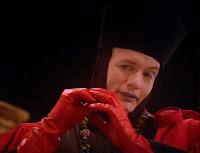 8. Q: (Star Trek) The archetypal trickster god, this omnipotent intellect delights in manipulating the Enterprise crew.
 9. Alpharius: (Warhammer) The youngest of his bio-engineered brothers, this planet-conquering general takes a resilience-based, ecological approach to combat strategy. Sometimes disappearing for weeks at a time simply to test the individuality and adaptability of his lieutenants, Alpharius is a man of secrets.
 10. Mr. Sinister: (X-Men) Originally a human geneticist in Victorian England, Mr. Sinister made a Faustian bargain with a higher power resulting in the loss of his family. He now exists to destroy that which created him.




Subscribe to:
Posts (Atom)