14. The perceived risk of getting 'doored' while biking close to parked cars is much, much lower in Atlanta. In New York, in my experience, a shockingly high proportion of parked cars have drivers sitting in their seats (doing what, I don't know). This might be because a larger share of NYC drivers are performing business stuff that requires precise scheduling. The lack of parking availability means that there's an incredibly high variance in the time it takes to find a spot. If you need to be parked and meeting someone at a specific time, you'd better start the search very early. A necessary consequence of that strategy is that lots of people get lucky and have to sit and wait in their cars. This sucks for cyclists.
Alternatively, it may be due to something more complex and subtle. Perhaps the congestion, lack of parking availability, or general stressfulness of driving in NYC means communication and planning tasks that ordinarily would be accomplished at the middle or end of a car trip need to be done before it begins. Whatever the reason, in my limited experience in Atlanta so far I haven't felt nearly as exposed while biking in the 'door zone', which is nice.
Showing posts with label Urbanism. Show all posts
Showing posts with label Urbanism. Show all posts
Sunday, January 25, 2015


Saturday, January 17, 2015
Very good questions to ask
The real question was whether low-income residents moved away from “gentrifying” neighborhoods at a higher rate than they did from nongentrifying neighborhoods.That's from an excellent piece in Slate about the vagueness and questionable utility of the concept of gentrification. Of course the opposite of gentrification--neighborhoods that stagnate and decline--is a much bigger problem that doesn't always attract enough media attention. I agree with mostly everything in the article, although the idea of community value in neighborhoods not being priced into the property exchange markets doesn't really come up.
Sunday, January 11, 2015
Observations on cycling in Atlanta compared to NYC
1. Atlanta is less dense and more spread out, meaning overall the utility of cycling is reduced (there are many important places that seem essentially unbikable). Outside of a few specific neighborhoods a car is basically required.
2. Bicycling in NYC is a competitive substitute for public transit because distances are very small. While moving trains and buses are faster, the fixed costs of walking to a station/stop and waiting are simply crushed by cycling, whose rapid movement begins immediately from any location. Add to this the fact that cycling is more point-to-point (no connections). Cycling in NYC also beats out travel by car, which must cope with terrible congestion and parking problems.
3. The distances in Atlanta are much greater, so the fixed costs of transit use are more compensated by the speed advantage once the train/bus gets rolling. This effect is somewhat offset by the added time required to get to a station/stop.
4. Cars aside, public transit options in Atlanta are so limited that cycling here (vs. NYC) may in fact be comparatively more valuable. This is mostly due to the tremendous coverage advantage cycling has over the public transit network.
5. There is much less cycling infrastructure in Atlanta (bike lanes etc.), but biking here actually feels safer than NYC. This is due to a number of factors.
6. Roads are less congested, so cars have much more physical space to safely overtake a cyclist by providing adequate passing room. Possibly related, the lack of congestion means motorists are more relaxed at stoplights and seem to accelerate much less aggressively compared to NYC (drivers in New York are stopped in traffic so often that they seize any open-road opportunity to zoom unsafely).
7. There genuinely seems to be a cultural difference that makes motorists more respectful and deferential towards cyclists. Possibly the lack of cyclists on the roads mean motorists aren't well-accustomed to car-cyclist interactions and take a risk-averse approach. This would cut against the conventional wisdom that more cyclists means safer cycling. Bottom line: NYC taxis are incredibly dangerous and fear-inducing, and biking in a city without them counts for a lot.
8. The quality and upkeep of roads and pavement seems to be much better than in NYC, whose infrastructure is crumbling and over-capacity. Fewer potholes and hazards means a less erratic biking line, meaning a safer trip.
9. Better weather.
10. Atlanta has many fewer pedestrians competing for space on bike paths and street crossings. This mostly eliminates a big source of fear and confusion, and leads to a more calm and pleasurable biking experience.
11. The transportation benefits of Atlanta's Beltline greenway network are overhyped. Although it links several decently walkable neighborhoods (and is expanding), its advantage over the typically-empty Atlanta roads and streets is only moderate.
12. That said, the economic, cultural, and urbanist benefits of the Beltline simply blow any other bike path out of the water, including the Greenway in Minneapolis. Atlanta is so starved of walkable, pedestrian areas with mixed commercial and residential development that the Beltline--ostensibly a transit project--is most valuable as an economic engine. The Beltline has more commercial and residential entrances facing the path directly than any other bike path I've yet seen. In context, however, this great value is largely an artifact of Atlanta's absolute lack of walkable dense neighborhoods.
13. Contrary to popular opinion, it is in fact possible to bicycle from the central downtown area of Atlanta to Hartsfield–Jackson Atlanta International Airport using a small number of low-traffic frontage roads along the MARTA train path. It takes approximately one hour.
Tuesday, October 14, 2014
Book Review: Building a World Class Transportation System by Charles Marohn
Charles Marohn of Strong Towns recently released a short e-book laying out his analysis of the problem with our transportation system, and his plan to fix it. The core insights of Strong Towns derive from a brilliant realization: that by merging our analysis of planning, design and transportation engineering with public finance and economics we can discover surprising truths about what produces growth and prosperity on a fine-grained scale.
He begins by contrasting the current wave of transportation infrastructure building with previous waves, specifically the construction of the railroad and interstate networks. In contrast to today, previous systems were essentially 'low-hanging fruit': relatively small investments reaped huge gains in productivity. The returns on subsequent building was much lower: connecting two high-performing places creates more wealth and opportunity than connecting two medium- or low-performing places.
Two subtler points emerge from this story. One is an institutional ratchet effect. During the 'high-return' days, certain institutional norms and arrangements formed and became locked-in, even as the landscape of infrastructure in the US changed dramatically. This idea of 'drift' (or political decay in words of Francis Fukuyama), where policy institutions don't keep pace with changing realities, is rampant here.
The second point is more philosophical: by maintaining the institutional inertia of infrastructure building even as the ROI of these investments tanked, information-processing and planning-fallacy concerns became more potent. Without the feedback mechanism of prices to coordinate the effective use of scarce resources, infrastructure decisions are largely based on the priorities of the political system. As the low-hanging fruit was picked and finding high-value investments became more difficult, the political system's inherent informational limitations became more apparent (and more costly).
A large chunk of the book is devoted to articulating the core Strong Towns concepts and laying out a specific reform proposal. I don’t have much to add on this, only to say that his forceful argument against using excess tax revenue from financially-productive places (i.e. those that generate more tax revenue than they consume in public services) to build stuff in non-financially-productive places isn't a blanket argument against all geographic redistribution. His case is limited to the narrow domain of transportation spending, and even then his claim is actually optimistic. Marohn is saying that even a poor place with low growth can be 'financially productive' in an infrastructure sense, so long as it fully appreciates the full tax revenue and maintenance implications of public investments. This is where his framework’s conclusions intersect with localist and resilience-oriented movements.
The non-partisan, crossover appeal of Strong Towns is a big reason for its success: it uses economics-style analysis (traditionally associated with conservatives) to arrive at conclusions traditionally associated with liberal urbanists. This leads to novel and intellectually satisfying arguments on many topics. A good example is the suburbs: liberals have long disparaged this pattern of development, but often in scattershot, wishy-washy, and vaguely elitist ways. Strong Towns gives us at least one good reason why the suburbs are terrible: the ratio of private investment to public investment is such that these regions are a net drain on the public purse.
In general the book is good, although its target audience suffers from a 'missing middle' problem. For someone who's unfamiliar with Strong Towns, this is a solid introduction that encompases most of the approach’s flavor. At the other end of the spectrum, this book will be valuable to readers with a technical or professional interest in learning about the finer details of a Strong Towns vision of policy. For amateurs already well-versed in the framework, but lacking a reason to deep-dive into the particular magnitudes of financing ratios, this book is somewhat lacking.
Marohn concludes by gaming out the winners and losers of his public finance reform proposal. It's an interesting attempt at political analysis, but it seems half-baked: some of his claims are overly optimistic, and the actual coalitional breakdown of any major reform in transportation will likely be as familiar and intractable as always. At times the book slips into the, "nation of whiners" and "people are stupid" rhetoric (common among certain subversive urbanists), which is obnoxious, although perhaps understandable given the epidemic amount of wrongness that exists in this field.
Saturday, October 11, 2014
Engineering a safer Central Park, ctd.
Stephen Miller from Streetsblog states the case for a car-free Central Park much more elegantly than I:
It’s unreasonable for a cyclist to assume that a green light means the path ahead will be unobstructed by pedestrians, just as it’s unreasonable to expect cyclists to come to a full stop when it’s safe for them to slow down and navigate around people crossing the loop, just as it’s unreasonable to expect a pedestrian to wait for the light when there is clearly a safe opening to cross.
Getting rid of traffic signals in the parks is a necessary step toward creating loop roads where people on bikes and on foot rely on eye contact and common sense to safely interact, instead of rules that don’t fit the context. And before that can happen, it’s time to finish the job and make the parks permanently car-free, a top request among Central Park users that has support from nearby community boards. Transportation Commissioner Polly Trottenberg says she’s heard the call loud and clear, but she hasn't committed to actually following through, citing the need for more study and consensus-building.
Tuesday, October 7, 2014
San Francisco's housing market is really screwed up
A few months ago Tech Crunch ran this fascinating, epically-long analysis of San Francisco's housing disaster. A taste:
Rent control is a naturally divisive topic in the tech community. Progressives view it as a sacred right that protects the remnants of a working- and middle-class in the city. “It’s a non-renewable resource,” Erin McElroy, who is part of the Anti-Eviction Mapping Project, explained to me.
But the tech community is both socially liberal and market-oriented, with more than 90 percent of political donations from Apple and Google employees going to Barack Obama in the last election. So price controls in the name of community stability and equity just makes people’s brains explode.There are numerous interesting nuggets and concepts packed into the report, but a big takeaway for me is just how strange the politics of land use are in most cities. Most cities are overwhelmingly dominated by Democrats, but there seems to be a huge opportunity for Republicans to naturally extend their governing philosophy and take a strong market urbanist position on these issues. The policy solutions are just waiting collecting dust.
Monday, September 22, 2014
Engineering a Safer Central Park
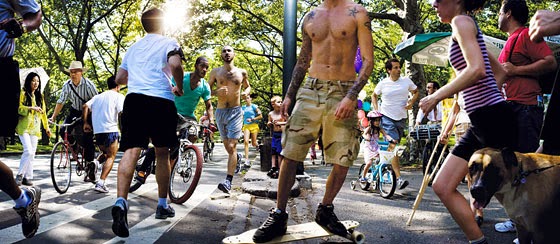 |
| It's chaos out there... but why? Photo Credit: NY Magazine |
I propose a somewhat counterintuitive theory: that the existence of signalized intersections (of which there are many) actually contribute to the dangerous pedestrian-cyclist interactions that occur on a daily basis in Central Park. First, consider that spandexed cyclists will always try to conserve their speed (rightly or wrongly). Due to congestion and road disrepair, New York City has few local opportunities for cyclists to achieve sustained high speeds. Rightly or wrongly, this means the Central Park loop will attract many aggressive spandexed cyclists.
Next, consider that the vast majority of pedestrians don't utilize structured intersections to cross the roadway--they don't need to. People can simply cross the gap anywhere (it is a nice green public park, after all). Cyclists, meanwhile, use the ample road width to subtly adjust and filter through pedestrians, joggers, slower cyclists etc. and proceed on their way. This is what happens over 99% of the road space on the loop. The mutual appreciation of shared space forces a level of awareness and emergent cooperation that minimizes the potential for crashes.
Typically when cyclists approach red lights in the loop there are no pedestrians around, so they just roll through. No harm done. Conversely, when a pedestrian faces a 'do not walk' sign, there are often no cyclists around, so they just cross. Again, no harm done. At signalized intersections, however, this all breaks down. What happens at intersections during peak times is that the unofficial norm of mutual filtering comes into direct conflict with the explicit directions of the signal lights. This creates chaos in several ways.
Some pedestrians follow the signals, and some follow the norms. Pedestrians who follow the signals and wait for a 'walk' sign clump up and create a large group of people that, when finally crossing, minimizes the gaps available for spandexed cyclists to filter through. This creates a dangerous situation.
Similarly for the cyclists, some stop at red lights, and some don't. When many (typically casual) cyclists stop at red lights, they clump up and create a barrier that minimizes the gaps available for spandexed cyclists to filter through. Signalized intersections, perversely, create the congestion which leads to unsafe pedestrian-cyclist interactions.
Signalized intersections are extremely expensive to maintain, and should be replaced with other passive traffic-calming devices that would better encourage safe interactions between pedestrians and cyclists (and cars, although given their low volume its surprising they're still allowed in the park). Signals were designed for auto-centric roads, and their continued existence on Central Park's pedestrian- and cyclist-dominated loop serves no purpose other than to confuse and muddle what should be pleasantly mutualistic and safe human interactions. So let's save some money, save some lives, and give Central Park back to its people.
Monday, August 18, 2014
What is the Target Efficiency of Affordable Housing Policies in NYC?
A provocative argument that it's not very good:
"Why is it in the nation's interest to spend federal dollars so arts industry folks can reside in one of the world's most expensive neighborhoods? Why don't affordable housing set-asides ever go to back-kitchen restaurant workers, house cleaners, or car wash employees? The answer: Those jobs aren't a stepping stone to more lucrative employment, so they don't appeal to college-educated elites.Giving poor people cash in the form of a negative income tax or something would let them decide how much they value living in desirable locations (by renting or buying market-rate). I suspect that if given the choice to pocket a bunch of money and live in a cheaper area, many would opt for this. The social mission of keeping certain areas economically diverse does seem important, but let's not forget it carries a social cost of its own, in the form of less well-targeted aid to poor people.
Wednesday, August 13, 2014
Automated Speed Cameras Could Revolutionize Road Safety
 |
| An underutilized asset? Photo credit: autoblog.com |
A second approach seeks to understand road safety outcomes by looking at the intrinsic motivations of individual actors in the system. Are there cultural or social norms that make motorists or pedestrians act in certain ways? How do certain populations vary in their risk factors for road safety behaviors? Common interventions under this framework might be educational awareness programs, signage telling motorists to slow down or share the road with cyclists, etc.
A third approach sits in between these structuralist and motivation-based approaches: enforcement. If we assume every motorist, pedestrian and cyclist has some abstract baseline road behavior that is sub-optimal from a road-safety perspective (i.e. motorists prefer to go faster, pedestrians prefer to cross streets wherever), enforcement can artificially raise the costs of unsafe behavior, changing the internal cost-benefit calculation of individuals.
 |
| Photo credit: wikimedia commons |
The two dimensions of enforcement interact with psychology in complex and interesting ways, but I tend to subscribe to the "swift and certain" application of enforcement for road safety violations. Basically the idea is to dramatically increase the probability of getting caught for a violation, and implement a small-magnitude punishment as quickly as possible.
This brings us to automated speed cameras. Currently this technology is mostly utilized at dangerous intersections to identify motorists running red lights. If a simple algorithm sees a violation, it snaps a photo of the vehicle's license plate and the driver gets a ticket in the mail. I'm no expert in algorithmic pattern recognition or machine learning, but I suspect it's possible to make these cameras do much, much more. Developing more advanced programs to expand the reach of automated cameras into areas like failing to signal or passing a cyclist too closely would be a major boon to road safety efforts. Even $5.00 tickets for something as minor as blocking a crosswalk would likely result in safer streets if motorists knew they would get caught.
A major benefit of these enhanced speed cameras is their feasibility: making the physical landscape of cities safer for pedestrians and cyclists is often expensive and always controversial. Changing the culture and norms of motorists, pedestrians and cyclists is really hard and takes time. Setting up a pilot system of enhanced speed cameras and sending out tons of tickets is an intervention that would be fairly invisible and occur largely in the back-office of municipal buildings. Even if privacy concerns bubble up, using probationers or parolees as a test group should be relatively straightforward and uncontroversial. Let's give it a shot.
Monday, August 11, 2014
A Few Thoughts on Streetcars and BRT
Streetcars have been taking a major beating lately in the urban policy wonkosphere (justifiably in my opinion). The latest is an Economist takedown that covers most of the major critiques. A few additional thoughts:
1. True bus rapid transit (BRT)--in designated protected lanes--is far and away superior to streetcars. BRT is much faster, cheaper (initial and upkeep), and more easily modified (i.e. stops can be added and subtracted easily).
2. Streetcar lines, if shared with traffic, create a horrible safety hazard for cyclists in the form of embedded rails.
3. The Silver Line in Boston is a good example of a true BRT system--it's great!
4. If the primary benefit of streetcars is their permanence (thus spurring private development), this is an incredibly inefficient and costly way to send a signal. There are cheaper ways to signal the permanence of public transportation upgrades (BRT lane barriers, protected stops, protected pedestrian paths and bike lanes etc.).
5. I suspect much of the lustre of streetcars comes from their historical and cultural associations. Conversely, much of the aversion to true BRT is likely due to their physical resemblance to regular city buses and all the sociological baggage that entails.
6. A major benefit of streetcars is their visibility and fixed routes. City buses are not nearly as accessible to newcomers or tourists because of the uncertainty about whether they'll show up, whether you've gotten on the correct bus, and whether you'll get off at the wrong stop. Because bus systems have fungible metal, most don't have fixed route maps inside for passengers. True BRT systems solve all these problems.
7. Indeed, Washington DC's Circulator bus system solves all of these accessibility problems without even being a BRT system. Clever branding, simple and few routes, high(ish) frequency and dedicated equipment go a long way towards patching public transportation voids.
Sunday, August 3, 2014
Quote of the Week
"Pasadena returns all of its meter revenue to pay for added public services in the metered neighborhoods, and Old Pasadena is a good example of the benefits. Old Pasadena was until the 1980s a commercial skid row and now it is one of the most popular shopping destinations in Southern California. Parking meter revenue helps to explain that success. The meters, which were installed in Old Pasadena in 1993, bring in $1 million a year to spend on in added public services in just that little shopping district. The meter money paid to replace all the sidewalks, streetlights, street trees, and street furniture. It paid to clean up the alleys and put electric wires underground. The meter money also pays to pressure wash the sidewalks twice a month and to provide added police services. If LA adopted Pasadena’s parking meter policy, all of our business districts would be much more prosperous. Residents of LA would not have to go to Pasadena or Santa Monica or Culver City to walk around in clean and safe environments."That's UCLA economist Donald Shoup talking about parking policy in LA. He's the author of the fantastic book The High Cost of Free Parking, which applies economic theory to questions about parking.
Thursday, July 31, 2014
Environmental Gentrification
CityLab has an interesting piece covering some new research into the effects of brownfield reclamation on nearby housing prices. Establishing causation in environmental areas like this is notoriously difficult, but if there is a real effect here it leads to an interesting question about the process of gentrification: will proposed environmental improvements come to be seen as threats to low-income communities, just like new condos or transit links? I sort of doubt it. But why?
Typically anti-gentrification groups fight a new development because they see it as having the potential to raise housing costs, pushing existing residents out and destroying embedded community value. Via the process of public reasoning, some projects are seen to have benefits that outweigh these risks, while others are not and are opposed. In this framing, residents might accept environmental improvements simply because the benefits of reducing exposure to environmental hazards are seen as a worthwhile tradeoff compared to gentrification risks.
An interesting feature of this is the large overlap between environmental justice coalitions and anti-gentrification coalitions. Whether environmental improvements are projects that might split these two groups is a really interesting question. More fundamentally, to what degree does the ideal of environmental justice conflict with the ideal that residents should be free to make their own personal decisions regarding the tradeoffs between environmental quality and housing price?
Monday, June 23, 2014
The Arc of History Bends Towards Bicycle Safety
NYC mayor Bill De Blasio today signed a collection of traffic-safety bills into law, most notably increasing the penalties for cars hitting bicycles with the right of way:
Intro 238-A makes failing to yield to pedestrians or cyclists with the right of way a criminal misdemeanor, not just a traffic violation, punishable with fines and jail time. If the driver injures a pedestrian or cyclist with the right of way, penalties increase to a $250 fine and 30 days in jail.This is great news, but there still exist a number of wicked problems related to bike safety. For one, many bicycle lanes are painted in the 'door zones' of parked cars, forcing safety-conscious cyclists to disregard them and ride farther out in front of motorists, antagonizing them. In general, many bicycle lanes face upkeep issues, with metal plates, gutters, or other debris partially or completely offsetting their safety benefit. More conceptually, nobody has yet discovered a solution to the 'right hook' situation where turning motorists cut-off cyclists proceeding straight forward.
Saturday, March 1, 2014
Is Small Urban Manufacturing Really Manufacturing?
I often hear vague talk of a new manufacturing renaissance in cities, one driven by technologies like 3D printing and robotics and sometimes grouped with various hipster-bobo artisanal products. But how similar is this new class of manufacturing to traditional categories like automobiles in terms of positive spillover effects? A few thoughts:
- The stated promise of this new sector is to radically increase productivity in manufactured goods by lowering initial capital expenditures, increasing customizeability (thus increasing potential aggregate market), reducing inventory costs (thus reducing short-term financing demands), increasing responsiveness to changes in market demand, and reducing transportation and infrastructure costs by producing close to market.
- Manufacturing has historically been advantageous in growth and development because using machines to make stuff has allowed big productivity gains without big education and skill gains. Factories can employ low-skill/low-education workers, and teach them how to operate equipment.
- But much of the hot new manufacturing in rich cities is more like the service or tech sectors--it requires high existing levels of skills and education (creativity, computer skills, etc.). This makes me very skeptical about claims regarding the race/class/employment benefits of any urban manufacturing renaissance. These businesses will draw their workforce away from existing high-skill/high-education jobs instead of hiring from low-skill/low-education labor pools. In fact, fast food restaurant jobs share more similarities to the urban manufacturing/factory jobs of old in terms of skill requirements and advancement opportunities.
- These new industries aren't geared as much around trading. That's one of the biggest advantages of traditional capital-intensive manufacturing: the barriers to trade are low compared to other sectors like services. Focusing more towards home markets reduces the need for firms to develop flexible marketing and supply-chain systems, limiting knowledge learning and the ability to scale up.
- I worry that if local urban manufacturing really takes off the reduced demand for imported goods will put developing nations at a disadvantage because they won't be able to rely as much on manufacturing for export as a development path.
- The fact that expensive high-rent cities like New York have so much primo land (on the water, near retail hubs, etc.) still devoted to comically-low-value uses like warehouse storage and parking is a sad reflection of how screwed-up the land market is (zoning restrictions, excessive veto power over new construction by local residents etc.). Maybe the urban manufacturing renaissance can use these spaces and get the land closer to its highest and best use. This to me seems like the most undervalued benefit of small urban manufacturing. But never forget, these low-productivity spaces shouldn't even be there any more! By far a more optimal use would be to change zoning and building restrictions to allow developers to just demolish all the warehouses and old blighted factories and build housing and office towers and stuff.
Saturday, October 12, 2013
5 Pointz is Being Demolished to Make Way For Condos, and That's Okay
 |
| Photo Credit: deathandtaxesmag.com |
In a long-awaited move, the owners of the iconic graffiti space 5 Pointz have finally cleared the last regulatory hurdles required to tear down the building. The land will be replaced with high-rise condos and some affordable housing units.
Undoubtedly some groups are upset. 5Pointz is an amazing example of skilled artists collaborating semi-spontaneously to create a beautiful amalgamation of art. But the disruptive logic and churn of urban evolution and growth is ultimately a greater boon to society, and I see this development as positive for New York, and the graffiti movement.
For one, the Long Island City neighborhood has seen tremendous gentrification and associated housing cost increases. LIC desperately needs new units to relieve this stress, and for all its amenity value, 5 Pointz is ultimately a fairly passive block of unused space. Additionally, dealmaking seems to have ensured that many individual surfaces will be preserved and displayed.
Rules that limit development, such as height caps and historic preservation designations, clearly have an important role in creating great cities. But often these powers are excessively utilized by incumbent residents and landowners to block changes, muddling the clarity of property rights. If a site like 5 Pointz is truly valued as an artistic work, artists and appreciators should "vote with their pocketbook" and pool their money to buy the land for preservation. If preservationists can't compete in an open bidding process, there's a strong prima facie case that preservation isn't the socially optimal use of the space. Market outcomes tend to allocate land efficiently, and overriding this useful mechanism should require exceptional social consensus.
On another note, excessive preservationism seems quite intellectually opposed to the essential character of graffiti culture. Part of what makes the graffiti enterprise subversive and exciting is its outsider perspective: artists critique the establishment by abusing written rules in adherence to deeper social norms about freedom and public acceptance. Aggressively employing institutional tools to preserve in amber artwork that revels in its own impermanence and material resourcefulness reeks of contradiction. Graffiti is about supplementing the artistic and public spirit in cities, which often gets undersupplied by capitalist land use and architecture. This works best on marginally productive surfaces, and once higher-value uses get identified and implemented, artists should gracefully step aside and move on.
Besides, I suspect the developers will face a massive onslaught of protest graffiti for some time as attached artists mourn 5 Pointz's destruction. Perhaps that's a healthy informal punishment for destroying such an impressive artistic site.
Sunday, August 18, 2013
Ingredients of a Good Bike City
 |
| What would Jesus ride? Photo Credit: backalleybikes.wordpress.com |
The idea of identifying "the best bike city in America" (or something along those lines) is one that pops up with a fair degree of regularity. But what exactly does it mean? Most traditional rankings look at certain urban amenities that support the enterprise of bicycling, with some taking into account slipperier factors like observed biking levels or motivation. In fact these two approaches are linked in a complex relationship that makes simple list-making tricky. What we're really looking for is the capability to flourish on a bicycle: what cities enable the ability for anyone to employ well the bicycle to pursue their goals of living a good life. A few thoughts on some relevant bike city elements:
- Bike Lanes: Clearly these are nice, and make everyone feel safer. The amount of bike lanes is easy to measure and easy for politicians to brag about, but what's more important is the quality. Is the paint fading? Do they disappear and pick up again on the other side of the street? Are they separated by medians or parked cars, or do they hug the edge of the road, forcing cyclists to make the no-win choice between exposing themselves to either dooring or collisions from passing motorists. Consistency in bike lane design is massively undervalued. Do they go along sensible, efficient routes? Also, do they get cleaned? I've personally been excited for the construction of a new bike lane only to see it fill up with gravel, broken glass, and puddled water. Upkeep matters.
- Road Quality: This doesn't get a lot of attention, but boy does it matter. Smooth, well-paved roads make biking dramatically more enjoyable. Safer too: fewer obstacles in the road means a less-erratic riding line. Big east coast cities are old, with crumbling infrastructure. Younger cities experiencing population booms out west probably have better roads.
- Density: In the broad scheme of things, this is the most important factor influencing the quantity of cycling. Simply put, if you live in a rural area, you won't be able to substitute biking for driving due to the large distances between stuff. But average population density can also be misleading; what really matters is architectural density. Los Angeles has an impressive average population density, but the road-centric urban form makes cycling less appealing. Philadelphia has a tight, cramped city core that limits the speed and craziness of drivers, making cycling dramatically more enjoyable.
- Weather: The influence of weather on cities is tricky to measure. One can say that, all thing equal, warmer cities are better for biking. But in reality there are simply not enough big cities in each climate to cancel out all the effects from other factors like urban form, history, culture, politics, etc., so we'll never know.
- Norms: Do drivers and cyclists have a respectful or adversarial relationship? Do motorists and pedestrians regularly occupy bike lanes? Norms receive a lot of attention because they play into the "style" and "identity" of notorious bike cities like Portland and Amsterdam. No doubt this factor exists to some degree. But much of what we assume derives from some special cycling je ne sais quoi actually comes from other factors. The more people who cycle, the more well-trained motorists and pedestrians will be to notice them. Variation in local traffic enforcement rules also structures the decisions of motorists and cyclists.
- Psychic Torment: Perhaps the best way to identify great bike cities is to look at the actual experience of riders themselves. For some, cycling is terrifying. For others, it's a delight. Why not just ask people!? The popularity of cycling as measured by public opinion polling surely varies by city. Throw in some survey questions like, "do you wish you could bicycle more, less, or about the same as you do now?" and you've got the makings of a sophisticated account of which cities are great for biking. A benefit of this approach is that it incorporates both the supply of bike amenities (like density and bike lanes) and the psychological profile of cyclists. Some hipster bike salmon are going to ride on any road, no matter what--do we really want to count those people when considering the best bike city?
- Motivation: On a related note, should considering why people bicycle play a role in identifying great bike cities? Some people choose to cycle for recreation or exercise. Others may choose not to cycle because they're unhealthy, old, or obese and it's physically strenuous. Big east coast cities have tons of food delivery people zooming around on bikes for a paycheck. Some ride bikes because they're poor and can't afford other options. Underlying this is a deep question about what drives people's transportation decisions. Biking exists within a world of trade-offs between walking, driving, and public transportation (and their respective inputs like public transit quality and gas prices). We can't just look at cycling in isolation. If we did, we might get the perverse result of a good bike city simply being one where public transit is terrible and driving sucks. When we're looking for the best bike city, does it matter that people adopt cycling for the right reasons?
The bottom line is that there's no clear way to identify the best bike city. The supply of bicycle amenities isn't something that you simply maximize to win the title. Different people bike in different ways, for different reasons, and you have potential confounding factors like demographics: young, fit people cycle more, so cities with more of those people record higher rates of cycling compared to older, fatter cities.
Perhaps the best approach for evaluating different cities and their relationship to cycling is to compare them to national averages. Presumably some demographic groups (race, income, education, age, health, etc.) have higher rates of cycling in some cities than others. By aggregating many different comparisons, you could see which cities "punch above their weight" so to speak.
Wednesday, May 22, 2013
It's Summer. But Who Cares, Weather Doesn't Matter, Right?
 |
The central business district in Minneapolis has an extensive indoor skyway system.
Photo Credit: Tech{dot}MN
|
Maybe. Isolating the total effect of weather on individual well-being is tricky to the point of being impossible. There are simply too many location-specific factors (cost of living, social and cultural opportunities, economic strength/wage levels, aesthetics, history, style etc.) that drown out any clear causal links. Psychological adaptability means that most people's happiness levels will quickly regress to roughly the same place following a big change in weather. Add to that the huge selection effects involved with people's decisions about where to live (i.e. finding a good "fit"), and it's pretty clear this is a minor and unimportant realm of social inquiry.
Nevertheless, a nagging intuition prevents me from fully accepting weather's irrelevance. Being outdoors has tremendous utility. We use the outdoors to exercise, socialize (most public space is outside), and move between indoor locations, to name a few uses. It seems self-evident that good weather increases the quantity of outdoor activity compared to bad weather. More specifically, good weather reduces the personal cost of doing stuff outside. Now, for die-hard year-round bicyclists, this doesn't matter too much. But on the margin, small changes in the costs of outdoor activities might reduce them below critical decisionmaking thresholds for some people, resulting in some higher amount of total outdoor activity.
If you consider health and outdoor activity to have some intrinsic worth (as opposed merely being instrumental in achieving personal happiness or life satisfaction), then areas with more good weather are indeed better off, however slightly. But in a different sense, good weather also increases personal freedom. Bad weather prevents us from doing things we want to do (would-be hikers are freed from the psychological torment of braving the cold, for example). Good weather increases our capability to achieve the functionings in life that we desire (exercise, stay up late without getting tired, etc.). Broadening the scope a bit, good weather probably has a disproportionately large affect on animal-welfare (the share of mistreated and unhealthy dogs almost certainly spikes in winter months).
Technology and infrastructure surely mitigate some of these effects (heated buildings, thermal underwear, etc.), but access to these offsets is itself a source of inequality and unfreedom. Vacation habits and patterns of homeless and elderly populations living in sunny areas bear this out. Additionally, the costs involved with bad-weather mitigation strategies are not trivial.
So later this summer, once your psychology has adapted and the good-weather euphoria has worn off, remember that in some very minor way, you're better off. And come next winter when bad-weather Stockholm syndrome sets in among your peers and you find yourself arguing with bad weather apologists ("I love winter, snow is so pretty" etc.), just smile and suggest a leisurely picnic in the local public park.
Friday, March 8, 2013
Why Is City Governance Often Terrible?
The Urbanophile blog recently posted an incredibly succinct comment about the poor quality of governance and public policy in cities, employing the analytical lens of public choice theory:
Another possibility is that the quality of elected officials on the city level is worse. I'm fairly skeptical that the link between politician quality and policy outcomes is really that tight, but it's not hard to imagine that lawmaking is a tough skill that takes time to master. If successful officials gain recognition for good work, they might tend to move upwards through the layers of federalism, leaving lower-quality governance in cities.
One peculiar fact that has almost certainly degraded the quality and efficacy of city governance is their long history of one-party rule. Democrats have had almost total control in urban areas for a very long time, with most electoral competition occurring in primaries between ideologically similar candidates. When one party stays in office long enough, interest groups inevitably gain power and influence. The basic mechanism of democratic accountability is broken when cities always vote for the same party regardless of policy outcomes. Republicans have little incentive to court urban voters with policy concessions (because they'll rarely win), and Democrats also don't need to compete for voters because they'll win no matter what. This basic phenomenon is a second-order claim about incentives and institutions, and is separate from one's party affiliation.
Lastly there's the possibility that this whole issue is merely a mirage--city governance may not be any better or worse than other levels of government. Cities face a unique set of challenges (poverty, crime, etc.) that may warp our evaluation of governance when looking at outcomes. Additionally, there are a great many cities in the U.S. Naturally we'd expect some to have above-average governance and some to have below-average governance, occurring solely by chance and contingent historical and contextual factors. The emphasis on terrible city governance in the news media might just be a particularly bad case of selection bias: everybody hears about the bad cities, but few hear about the good ones.
Economists have a concept called “revealed preference” that suggests that consumers reveal their true preferences through the actual purchasing decisions they make. Applying this to public policy, it’s hard not to come to the conclusion that the real preference of the powers that be in most places is the maintenance of the status quo, not disruptive economic development. It probably also explains why every city obsesses over “talent” publicly, but almost none of them undertake actions that might actually attract it for real.The problem of incumbent interests capturing and employing the tools of government to protect themselves from change isn't limited to cities (a classic example is a business group lobbying for regulation to keep possible competitors from easily entering the market), but might be most apparent there for several reasons. Density and the primacy of land use issues in urban policy means the dreaded NIMBYism is common. The relative ease of engaging with city government (as opposed to state or federal) means more NIMBY coalitions can thrive, and on a wider range of minor issues.
Another possibility is that the quality of elected officials on the city level is worse. I'm fairly skeptical that the link between politician quality and policy outcomes is really that tight, but it's not hard to imagine that lawmaking is a tough skill that takes time to master. If successful officials gain recognition for good work, they might tend to move upwards through the layers of federalism, leaving lower-quality governance in cities.
One peculiar fact that has almost certainly degraded the quality and efficacy of city governance is their long history of one-party rule. Democrats have had almost total control in urban areas for a very long time, with most electoral competition occurring in primaries between ideologically similar candidates. When one party stays in office long enough, interest groups inevitably gain power and influence. The basic mechanism of democratic accountability is broken when cities always vote for the same party regardless of policy outcomes. Republicans have little incentive to court urban voters with policy concessions (because they'll rarely win), and Democrats also don't need to compete for voters because they'll win no matter what. This basic phenomenon is a second-order claim about incentives and institutions, and is separate from one's party affiliation.
Lastly there's the possibility that this whole issue is merely a mirage--city governance may not be any better or worse than other levels of government. Cities face a unique set of challenges (poverty, crime, etc.) that may warp our evaluation of governance when looking at outcomes. Additionally, there are a great many cities in the U.S. Naturally we'd expect some to have above-average governance and some to have below-average governance, occurring solely by chance and contingent historical and contextual factors. The emphasis on terrible city governance in the news media might just be a particularly bad case of selection bias: everybody hears about the bad cities, but few hear about the good ones.
Thursday, March 7, 2013
The Postal Service Should Deliver Mail Once a Week
 |
| Photo Credit: Andrew Harrer/Bloomberg/Getty Images |
Congress' policy restrictions place the Postal Service in an impossible operating environment: the agency is expected to fund itself like any business and compete for customers, but its ability to make tough workforce and strategy choices is restricted. Given that most governments in the world have some form of mail delivery service, identifying an optimal set of policies shouldn't be that difficult: do a comparative analysis and identify what works and what doesn't. Unfortunately political incentives and ideology get in the way.
The employee union and customers have a direct stake in maintaining the status quo. In the absence of a powerful coalition supporting reform, lawmakers wishing to raise money and public support vote to maintain the status quo. This dynamic is timeless and won't change.
The philosophical arguments against reform, however, might be more amenable to change. The basic purpose of the Postal Service is to deliver mail. In the past, the "public good" nature of a national postal service was clear. Fostering a national identity, providing communication services to individuals living in remote areas, and establishing a ubiquitous and tangible example of the fruits of the social contract are all benefits that the market would undersupply on its own. Add to that the coordination benefits of having a single network provider and the argument for a strong national postal service seems pretty good.
But times have changed. Global corporations like FedEx could presumably provide similar services given the opportunity. Civic virtue and national identity are well-established and unlikely to degrade in the absence of daily mail delivery; indeed cheap and easy access to the internet is almost certainly more beneficial in this regard. By subsidizing the communication and parcel delivery needs of people living in rural and remote areas, the economic and environmental benefits of urbanization are reduced. Subsidizing the lifestyle of people without cheap and easy access to computers and the internet to such a large degree reduces the demand for investments in telecommunications infrastructure, and probably reduces the political demand for better internet and telecommunications policy.
 |
| Photo Credit: ThinkProgress |
Seen in this light, the Postal Service is a costly agency with an extremely low target efficiency. Perhaps just giving people money to purchase computers or internet connections would be a more effective. Perhaps directly providing computers or internet connections would be better (to allay the inevitable concern that recipients might spend the money on other things). Maybe increasing the funding and quality of public libraries would get the job done. Perhaps merging public libraries with the Postal Service is the answer--most parcels could be picked up rather than delivered and the combined real estate footprint of both institutions means most households would have nearby access. Why not allow private businesses to become middle-men in the mail delivery process: in New York City, picking up mail and parcels from a local Chinese takeout restaurant or bodega would probably be incredibly convenient for a huge share of the population.
At the very least, direct mail delivery to individual households should be reduced to one or two days a week. Paired with other reforms aimed at speeding the transition to internet-based communication services, this reduction would allow more public resources to flow to those who truly need them.
Saturday, September 22, 2012
Quote of the Week
"Today, New Urbanism finds itself in unexpectedly strong competition with "old urbanism," that is, with existing center-city neighborhoods in the process of renovation that are already well served by transit lines, close to lively downtowns with well-paying jobs, and enjoying rapidly improving schools, public safety, and other services. Not surprisingly, these neighborhoods have attracted many of the young people who might have fueled the demand for greenfield New Urbanist projects. Meanwhile, the American suburb has proved to be highly resistant to extensive reconfiguration along New Urbanist lines."--Robert Fishman writing in Planning Ideas That Matter edited by Bishwapriya Sanyal, Lawrence Vale, and Christina Rosan
Subscribe to:
Posts (Atom)