Wednesday, December 18, 2013

An Example of Good Government

Globalization and has exposed us to terrible risks
Photo Credit: improve.com
I tend to take a pretty cynical view towards government and the policy process in general, so it's important to highlight the occasional example of things going right. The FDA recently declared its intention to raise the cost-benefit bar for antibacterial soaps, forcing manufacturers to prove their health benefits.

Basic economic theory holds that when markets fail, government's role is to step in with a corrective. Classic examples might be antitrust rules (preventing monopolies), the Toxics Release Inventory (reducing information asymmetries between employers and workers), and taxes on alcohol (forcing prices to reflect the true social cost of goods).

Reducing the quantity of antibiotics floating around by making their production and distribution more costly is a perfect case of government action. Individual pharmaceutical firms don't have to bear the full social cost of increasing antibiotic-resistant bacteria, so they produce more antibiotics than is optimal. The FDA is internalizing this externality. Although antibiotic-resistance is a problem in the here-and-now (reducing the efficacy of drugs), its real harm is to increase the tail risk of global pandemics. Such low-probability, high-impact events are often overlooked in public policy, so it's refreshing to see some action on this front.

Facebook Isn't Doomed

Jay Yarrow in Business Insider today had an interesting piece on Facebook, saying it's doomed because sleeker one-function apps like Snapchat and Twitter will crush its individual services, which are complicated and burdened by the need to all fit together. This is certainly a real problem, but I think he underappreciates the resilience of Facebook's position and the simplicity with which the issue could be fixed.

Facebook has a tremendous advantage simply by being the first, biggest, and most popular social networking service. Good networks are all about scale, and Facebook remains the most important medium for maintaining relationships across time and space. Additionally, by bundling together different services, Facebook insulates itself from the failure of any single one. This allows time to adapt and incorporate whatever innovation an upstart competitor may have created. The rise of Twitter was a major challenge for Facebook, but its existing customizable profile pages, simple messaging service, and weird "poke" thing remained enjoyable enough to allow the rejiggering of the "wall" into the Twitter-like news feed.

The issue of too many functions creating too much noise could possibly be corrected with better sorting algorithms or design, but here's an even simpler solution: break Facebook into chunks. If problems arise when many different services have to be packed together on the same webpage or application, why not release a bunch of apps that do just one thing? Have a "profile viewer" app, a messenger app, a photo app, etc.  By erecting optional barriers between Facebook's different services, it could partially replicate the design advantages of its competitors. Having a number of minor Facebook apps would also allow experimentation with different color schemes, something that might be helpful in establishing a sheen of "newness" for all those cool-hunting kids.

Sunday, December 15, 2013

Epigenetics Can Help Fix Nutrition Science

Aeon recently posted a great essay critiquing the popular 'selfish gene' analogy, exploring new layers of complexity biologists have since uncovered within the process life uses to propagate itself. One of the hottest new concepts has been 'gene expression' or epigenetics. It's basically the insight that not all genes affect their organism in the same way; some heritable changes can occur that aren't caused by changes in DNA sequence. This promising new field muddles the nature/nurture question in a most intellectually-rewarding way.

One of the greatest potential applications of epigenetic thinking is in the field of nutrition science. Explaining exactly why someone's body fat percentage is what it is remains a murky and contentious area, ironic given the global obesity epidemic. Much of the confusion stems from the difficulty in parsing out heritable effects from lifestyle and cultural factors. As an example of the theoretical clarity epigenetics can provide, consider this question that I've long wondered about (and never found a satisfactory answer to).

Most people agree body fat percentage is in part driven by heritability: kids tend to share the body type of their parents, and we all know people who can eat whatever they want and remain skinny. This heritable component likely contributes to the difficulty people experience when trying to change their basic body type in a sustained way.

So here's my question: say you have a heterosexual couple, both with a propensity to fatten, and they've lived much of their lives overweight. If they had a kid, odds are the kid would share this propensity. Now consider what might happen if the couple decided to buckle down, lose weight, and get in shape. What would happen to the kid? The parents' genes certainly haven't changed, so one might expect the kid to still be cursed with a propensity towards accumulating body fat. But it seems strange to imagine, say, parents who've been thin and fit for 10 years having a kid with a propensity to fatten.*

Epigenetic effects can help explain why this scenario seems unlikely: after 10 years of thinness, the parents have probably undergone major biological changes that are somehow 'locked in' and get passed on to their children.

Hopefully researchers will someday be able to understand the exact dynamics of interactions such as this. If we knew definitively, for example, how long parents must sustain weight loss in order to gift a thinness propensity to their children, it would be a tremendous benefit to society. One can easily imagine compassionate parents being strongly incentivized to lose weight and get healthy themselves in order to enable their children to live better lives with greater opportunity.

*admittedly there's some confounding effects here: parents who are able to make big lifestyle shifts like sustained weight loss probably are insane fitness nuts who are likely to influence the behavior of their children

Friday, December 13, 2013

Quote of the Week

"The crux of the problem is that our national data systems and the social facts they produce are based on a normative view of economic and domestic life as stably situated in households. As a  result, people who are institutionalized, unstably housed, or tangentially connected to households are commonly overlooked in statistical portraits of the American population.
 In this book, I show how inmates and former inmates are categorically and systematically excluded from the data collection efforts that frame American social policy and social science research. Their exclusion clouds our understanding of the American economic, political, and social condition. Decades of penal expansion coupled with the concentration of incarceration among men, black, and those with low levels of education have generated a statistical portrait that overstates the educational and economic progress and political engagement of African Americans."
That's from the foreword of Invisible Men: Mass Incarceration and the Myth of Black Progress by University of Washington sociologist Becky Pettit. While biasing statistical data sets probably isn't the most consequential effect of mass incarceration, it certainly is shocking and a great example of the difficulty inherent in most large-scale statistical research. When Noam Chomsky talks about "objective" in the media and big governing institutions really meaning, "from the perspective of the rich and powerful," this is very much the type of thing he's referring to. For deeper look check out this fantastic EconTalk interview with the author.

Thursday, December 12, 2013

Information Nexus

1. Must-Read Fukuyama of Political Decay
2. Solid Mashup of 2013's Big Pop Music Hits
3.  Minimum Wage Vs. EITC
4. Excellent Short Film on the Plight of Pine Ridge Indian Reservation
5. Does Nelson Mandela Prove That Leaders Matter? and this Response

Reviewing Movies From 10 Years Ago is Risky

Ed Power in Slate has an interesting article today critiquing New Zealand as the filming location for the Lord of the Rings trilogy, basically arguing that Middle-Earth is described in the books as much older and darker than New Zealand's geography allows for. I'm fairly agnostic regarding the importance of fidelity to source material in film adaptations (there's much to be said for stylistic differentiation and uniqueness of vision), but he makes a good case--almost.

Setting aside the obvious fact that Peter Jackson's representation of Middle-Earth was driven by many more factors than simply filming location, I think Power falls into a fallacy that's common in reviews for movies released a long time ago: he evaluates decisions made 15 years ago using the film standards of today. While the passage of time occasionally allows positive and negative truths to emerge by filtering out noise (judging presidents, for example), in this case it warps his analysis by setting up an unfair standard.

Critiquing the Lord of the Rings trilogy as insufficiently dark and gritty ignores the effect the films themselves had in establishing that very expectation. The films were major global hits that shifted the trajectory of fantasy moviemaking towards gritty epicness, setting the stage for the current state of gloomier, quieter fantasy. Lord of the Rings was plenty dark when it came out, and it's unfair to claim it didn't go far enough.

Note: Although the Hobbit movies are being released now, fundamental decisions like filming locations and cinematographic style are essentially locked-in from the previous trilogy.

Wednesday, December 11, 2013

The Planet Money T-Shirt is Going to Have a Huge Black Market

Planet Money, a fantastic radio show/podcast/blog popularizing economics has recently been working on a cool project following the complete supply chain of a simple branded cotton t-shirt. The idea is an extension of the book Travels of a T-Shirt by Pietra Rivoli that many of us probably read in an introductory macroeconomics class.

Delivery of the shirts is fast approaching, and naturally the coverage and publicity of the endeavor is increasing. Strangely, however, only people who pre-ordered the shirts months ago during the very earliest phase of the project will be able to purchase them. If you've recently been turned on the the show, or are just now hearing about these t-shirts, you're out of luck. My prediction is that the buzz surrounding these shirts will generate considerably more demand than the fixed pre-ordered stock, creating a financial incentive for certain enterprising econ nerds to resell them on a secondary market.

I suspect that encouraging this behavior may have been the Planet Money team's plan all along, and covering the secondary market would be a great opportunity to do a show on price discovery and the role that prices play in revealing information about consumers.

Is the New Mobile Tech Trend Solving or Bypassing the Real Problem?

This guy understands it's not all about energy efficiency
Photo Credit: ironman.wikia.com
Wired this week had a few good articles about a hot new (old) trend in the mobile tech arena: passive wireless communication between devices. Apple has a new system call iBeacon, and Foursquare is using clever programming to allow phones to automatically check-in. In both cases, the primary innovation is the reduction of battery drain. Seamless passive communication is a key step towards realizing the 'internet of things' and rebooting the failed Grafedia idea, so hooray.

Limits on energy storage have long been a limiting factor preventing engineers from packing ever-more goodies into mobile devices; lithium ion technology and micro-fuel cells are steadily improving, but not keeping pace with other design areas like miniaturization and heat regulation. Squeezing more utility out of existing batteries is great--it's maintaining the pace of advancement everyone's come to expect from mobile tech. The story of human progress has largely been one of increasing energy efficiency.

But in a certain way this trend represents progress along the wrong margin: the real problem is inadequate energy production and storage technology. Even the cool powermats that allow wireless charging are attempts to get around this nettlesome limit. Nearly all historic predictions about the future failed to recognize the great advances we've made in communications and information technology, instead emphasizing the wondrous gizmos enabled by a world of unlimited free-flowing energy. I'm glad I live in a world brimming with social and cultural change, but to truly realize the sci-fi future we've all dreamed about, we'll need more than awesome energy efficiency.

Tuesday, December 10, 2013

Unionization is Tough at the Low End

Wonkblog has an interesting and somewhat rambling discussion of the various troubles at one of the nation's biggest unions, IAM. The end contains an interesting nugget about some of the underlying dynamics of decreasing unionization in the US:
"If you're trying to organize a new group, it's usually a low-paid group, and how are you going to tell them they have to pay $70 a month, and they don't know what for?" Asuncion said in an interview. "It's the dues structure that's killing us."
I often hear liberals talk about the failure of workers at the low-end of the skill/wage spectrum to unionize and how it's an error of short-term thinking, but I think this quote is telling. Although low-wage jobs have less turnover than one might expect, not supporting unionization may very well be a rational economic calculation. Unions provide economic benefits to their workers in a less concrete, more long-term way. Dues, on the other hand, are paid monthly and take a greater share of total wages the lower you slide on the income scale. Add to this that the primary weapon of unions--the strike--is a potentially devastating strategy for low-wage workers who are struggling to get by each month. If employers know that strike threats have no teeth, the bargaining position of unions (and the benefits they can promise) becomes shakier. Additionally, an increased emphasis on organizational culture and employee engagement by business undercuts some non-economic functions of unionization, such as establishing a shared identity, improving workplace conditions, and aggregating information from lower organizational levels.

On a semi-related note, many professional athlete unions have difficulty bargaining with owners because their strike threats are equally romantic: if nearly all of your total lifetime income is made within just a few years as a sports star, losing just half a season is potentially very costly.

Monday, December 9, 2013

Absurd Protectionism in the Sugar Industry is Great!

The Washington Post recently had a horrifying report on the domestic sugar industry, which through political influence has managed to establish itself as a resilient rent-seeking coalition. Government protection via price controls, import quotas, and loan guarantees raises prices, enriching manufacturers while hurting consumers and impoverishing foreign producers. It all sounds pretty terrible--your classic public choice dilemma, right?

While it's true that this regulatory kludge makes almost everyone worse-off by economic standards (real income, productivity, growth), I can't help but see a paternalistic silver lining to the status quo. The state of nutrition science is increasingly converging on the idea that sugar is astonishingly damaging to individual health and is a primary driver of the epidemic of metabolic syndrome and its associated ailments (obesity, diabetes, Alzheimer's). While I haven't studied the elasticity of consumer demand for sugar, typically when you make something more expensive, you get less of it (though not always!).

The social and economic benefits of consuming less sugar are probably huge, and certainly under-appreciated. Having a healthy and vigorous citizenry is a virtue in and of itself, but also enhances the capacity of people to pursue and realize their own goals. A simple tax on sugar would be vastly more socially and economically optimal, but given the current sluggishness of our legislative branch, I'll take what we can get.

Friday, December 6, 2013

A Feminist Defense of the Taxi Cartel

In most major US cities, the taxi industry is highly regulated, mandating all sorts of service standards and ownership rules. Unsurprisingly, many of these rules seem to be designed to restrict the supply and innovation of new market entrants, thereby protecting incumbents (taxi drivers and taxi companies) by keeping prices high and revenue streams secure. The flip-side of this arrangement is that for most people, getting someone to drive you around in a car is more difficult, more expensive, and less convenient than it otherwise would be.

With the rapid adoption of smartphones, a few upstart companies (Uber, Sidecar, Lyft) are attempting to break into the field, offering consumers the promise of radically convenient transportation options through gps-hailing and ridesharing. These innovations threaten the high wages of incumbent taxi operators, and currently an ongoing political battle is being waged in cities across the country to negotiate the entry and potential disruption of the industry.

In general I've been very sympathetic towards the disruptors: they're bringing technology to an outmoded industry, they're helping usher in the 'service-and-flow' economy (also known as the sharing economy), and most importantly they're helping to increase the real income of city-dwellers by reducing the price and increasing the accessibility of transportation.

Most of the pushback I've heard defending the status quo typically revolves around either concern for the livelihoods of taxi operators, or safety. The first point is silly: existing taxi operators have no substantive claim on special wage supports compared to any other service sector, and the gains realized from reform would mostly flow to consumers, of which there are many.

Up until recently, I've been content to brush off safety concerns as basically a 'bootlegger and baptist' phenomenon: cartel defenders talk about ensuring minimum safety standards and the moral solemnity of taxi drivers, but that's just a marketing ploy to keep themselves well-protected from competition.

However, in a recent conversation on this topic I was a bit thrown off by a safety-based argument I hadn't truly considered: that because I was a man my framing and analysis of this issue had led me to undervalue the potential safety issues of a more unregulated taxi industry. The habit of getting into a random car with a total stranger without a second thought is a social achievement that's been built up over time in part because of government's explicit backing of taxi operators. Any potential change in this situation runs the risk of undermining the relationship of trust implicit between taxis and riders. It would probably only take a few highly-publicized murders or sexual assaults for a new unregulated technology-mediated taxi industry to lose trust and collapse.

Information Nexus

1. Explaining the Economics of Star Trek and a Response
2. Answer to a Question Everyone's Surely Asked
3. Skeptical Take on the Guaranteed Income Idea
4. Nice Analysis of the Bicycle Dilemma (and good hyperlinks too)
5. The Math Mutation Podcast Covers Arrow's Theorem

Saturday, November 23, 2013

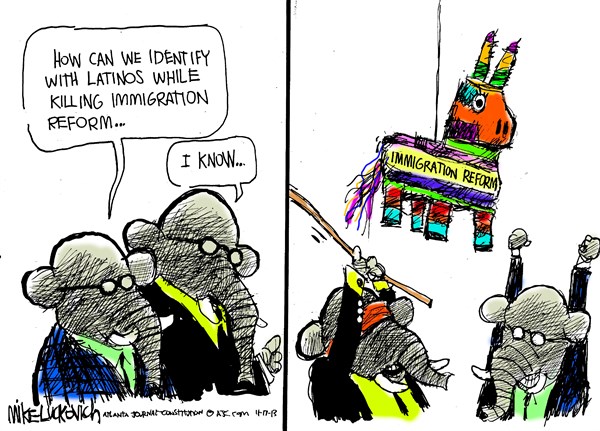
Mike Luckovich


Neologism Watch: Sousveillance

Jerry Brito this week has a great column on the idea of "sousveillance":
"Sousveillance is the recording of an activity by a participant in that activity, and it can be thought of as the inverse of surveillance. The word “sur” in French means “over” or “above,” hence surveillance is “watching from above” or “overseeing.” The word “sous,” by contrast, means “under” or “below.” To date, “veillance” has only been available to the powerful–whether through corporate or government CCTV cams perched atop buildings or utility poles–but with the advent of cheap wearable computers we will all soon be able to point a camera back at the powers that be from below."
Rapid adoption of technologies like smartphones, drones, and small wearable cameras really does necessitate an unpacking of the concept of veillance into more specific sub-categories. Sousveillance is creative, and provides a nice logical opposite to big institutional observation and recording. There's clearly still space in the middle, however, that remains undefined and murky. What should we call veillance that's carried out by individual participants but sponsored and organized by big institutions (Google maps, or police squad car cameras)? What about sousveillance that's collected in a disorganized distributed way but aggregated by central institutions?

Wednesday, November 20, 2013

Judge Pushes Back Against Nuclear Waste Regulatory Kludge

The question of what to do with nuclear waste has long bedeviled policymakers and industry participants. The stuff has been stored on-site in temporary pools since the 1980s, but power companies have been steadily paying into a government fund to develop a long-term solution. Most of the money has been spent researching and building a proposed geologic repository at Yucca Mountain in Nevada, which was cancelled by President Obama (a move undoubtedly driven by Harry Reid's clout and Nevada's early place in the presidential nomination process). It's an excellent example of kludgeocracy in action: no political majority exists to stake a risky position on changing the status quo, so we're left with an increasingly outdated and dangerous waste storage policy.

But in a rare move of governmental sanity, a federal judge ordered a halt to the collection of the storage tax:
"A federal appeals court ruled Tuesday that the Energy Department must stop collecting fees of about $750 million a year that are paid by consumers and intended to fund a program for the disposal of nuclear waste. The reason, the court said, is that there is no such program."
An interesting question now is whether this development will help or hurt nuclear energy's competitive prospects. On the one hand electricity generated by nuclear fission becomes cheaper, albeit marginally. On the other hand, the industry finally loses all pretense of on-site storage pools as "temporary".

Nuclear energy exists within an insane regulatory thicket of competing and contradictory subsidies and hindrances. Action to combat climate change and institutional links to military research helps the industry. Conversely, the ban on waste reprocessing (established after India detonated a bomb built from reprocessed spent fuel) severely limits the creation of a safe nuclear energy industrial ecosystem.

Halting the storage tax is a small step towards simplifying everything, but it seems that until cheaply available space flight opens up a safe alternative to geologic storage and reprocessing (shooting waste into the vastness or sun), we're stuck with a situation that's becoming increasingly dangerous and unsustainable.